INTENT
To enable all children to:
1. To investigate the beliefs and practices of religions and other world views.
2. To investigate how religions and other world views address questions of meaning, purpose and value.
3. Investigate how religions and other world views influence morality, identity and diversity.
4. To recognise commonality and difference within and between religions in order to develop respect,
openness and curiosity.
IMPLEMENTATION
1. We begin the teaching of religious education in Foundation Stage as the children begin to encounter
religions and other world views through learning about our family, special people, times, and places.
2. As the children move into Key Stage 1 they will build on their earlier work using the Agreed Syllabus
as the guidelines for teaching and learning.
3. Our curriculum follows 6 main pathways in religious learning; these pathways focus on different
aspects of belief that run through various religions and world views. These pathways are pathway 1
The Nature of Religion and Belief, pathway 2, Expressing Beliefs, pathway 3 A Good Life, pathway 4
Personal Journey, pathway 5 Influence and Authority and pathway 6 The Big Picture.
4. At all key stages, strong links will be made with the teaching of English. Stories, plays and poems
from the bible and other religious and moral sources will be shared with the children.
5. Religious Education will become a stimulus and a springboard for the development of oracy, writing
and for the development of thinking and reasoning skills.
6. Art and drama will be closely linked with Religious Education as children use these subjects to
communicate what they have learnt.
7. Where appropriate, teachers will use first-hand experience, visits, visitors, artefacts and the local and
wider environment to engage children’s interest and imagination.
8. Through their understanding of the different faiths and beliefs children will be encouraged to develop
their feelings and empathy and understanding for others.
9. Through their understanding of world religions, children will develop an understanding of the British
society in which they live.
10. Children will learn about rights and responsibilities, moral, spiritual, social, cultural and environmental
issues.
11. We will use financial resources to build up an extensive collection of resources, artefacts and books to
support the teaching of Religious Education.
IMPACT
The teaching and learning of Religious Education will promote excellence and enjoyment. It will have a strong
presence in the ethos of the school through displays, performances and assemblies. Religious Education will enable children to articulate their own views about religion and world views, developing understanding and
cultivating mutual respect, empathy and tolerance. Religious Education will help equip the children for life in
an inclusive society.
Curriculum
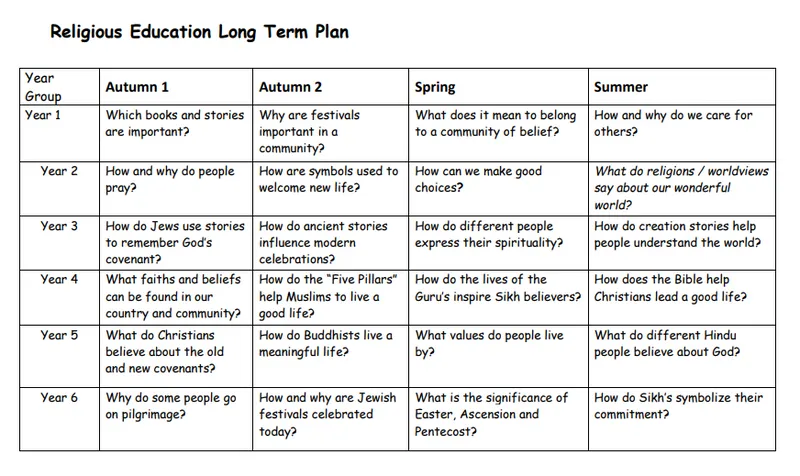
At Burnley Road Academy we follow the specially designed local scheme for Kirklees and Calderdale.
These are the topics for each year:
RE Policy
RE policy-2025
SMSC Policy.pdf
Cultural Capital in RE
‘It is the essential knowledge that pupils need to be educated citizens, introducing them to the best that has been thought and said and helping to engender an appreciation of human creativity and achievement.’
Ofsted School Inspection Handbook 2019
Our RE curriculum is designed to equip children with the knowledge and cultural capital to succeed in life. It provides children with essential knowledge about world religions and different communities so that they are well-informed citizens ready for the real world, in line with their more advantaged counterparts. Our curriculum covers a range of topics that link to religious and non-religious views that allow children to broaden their learning about different communities beyond their own.
Our RE curriculum also provides children with plenty of opportunities to develop their critical and reflective thinking which will support them in discovering their own journey of purpose and meaning in the future.